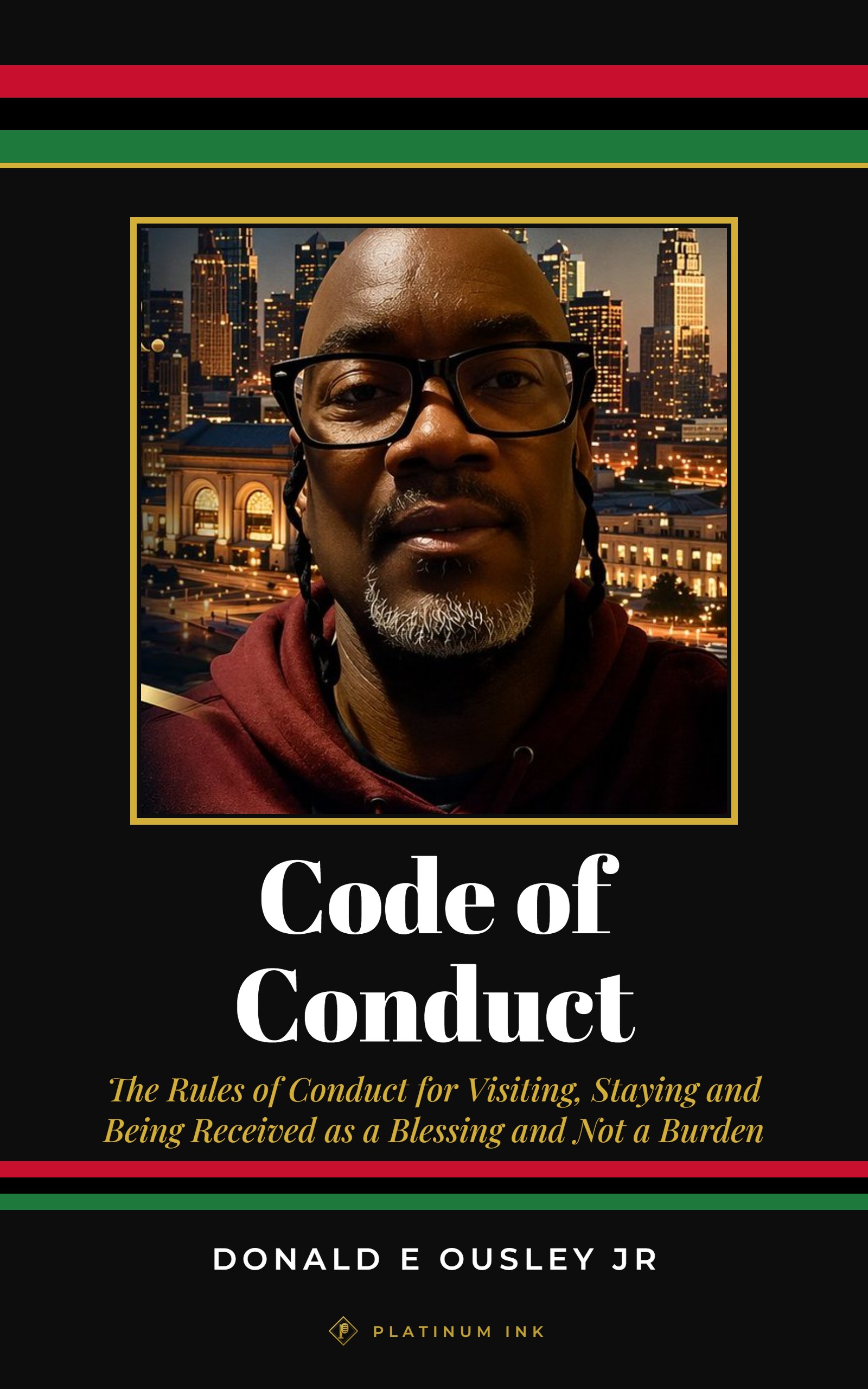
Code of Conduct
The Rules of Conduct for Visiting, Staying and Being Received as a Blessing and Not a Burden
by Donald Ousley
Buy now — $9.99Read it online the moment you pay — the link comes to your email.
About the book
There was a time when nobody had to explain how to act as a guest — you just knew, because somebody taught you before you ever walked through the door. That time is fading. This book is Donald E Ousley Jr's answer: a short, plain code of conduct handed straight from an elder to a young adult about to stay in somebody else's house.
Inside, you'll find real proof it works — Uncle Robert, who cooked, cleaned, and helped without being asked; a grandmother's family who acted like family and left every visit a blessing; and the author's own correction, given once by his uncle in Texas, accepted without argument, and never repeated. Each chapter hands you one numbered rule you can point to, ending with what to do the next time you walk into somebody's house.
This is for the young man or woman about to be somebody's guest, who wants to know exactly where the line is — and who's ready to either keep it, or leave with no hate and no noise.
Read the first pages
The Code
I am writing this because too many of our young people are walking into other people's houses off code. Not because they are bad. Because nobody sat them down and told them what the code even is. A generation of us grew up without the men and women who used to teach this at the kitchen table, before you ever left the house. So it wasn't taught. And what wasn't taught got lost. And what got lost turned into a Mad Max world where everybody is doing their own thing and calling it freedom, and nobody is accountable to anybody for how they carry themselves in somebody else's home.
This book is my answer to that. Not an argument. Not a lecture. A code.
You have seen the twelve steps somewhere in your life. Maybe on a wall, maybe in a book, maybe somebody you love carried a card with them folded in a pocket. Twelve steps, written plain, one after another, so a man in trouble could point to the one he was on and know exactly where he stood. That is what this is. Not for recovery from drink. For recovery from a world that stopped teaching you how to walk into somebody else's house and be a blessing instead of a burden.
Here is the whole code, all at once, so you can see the shape of it before I explain a single piece.
THE CODE
1. Your behavior and character reflect on you and your family. Always.
2. You do not wait to be asked to help. You look for what needs doing and you do it.
3. You clean up after yourself, and then some.
4. You are on time, or you send word.
5. You do not bring people into another man's house without his knowledge and his consent.
6. You do not speak on what you see or hear in somebody else's home.
7. You leave the house better than you found it.
8. You say thank you, and you mean it, and you show it.
9. You do not make yourself the center of another man's household.
10. If correction is given to you, you receive it without argument.
11. If you cannot or will not keep the code, you leave — with no hate and no noise.
12. You carry the code with you, into every house you ever enter again.
That is the whole of it. Twelve lines. You could write them on an index card and keep it in your wallet, the way men used to keep a card with the steps on it, folded soft from handling.
Every chapter after this one is going to take a piece of that list and open it up for you, slow, so you understand not just what to do but why it matters, and what it looked like when I saw it done right, and what it looked like the one time I did it wrong myself. I am not going to hide that last part from you. I broke this code once, in my uncle's house in Texas, and he corrected me, and I took the correction, and I never did it again. You will hear that story in its place.
But I want you to have the whole code now, today, before you read one more page. Because a man ought to be able to see the whole road before he starts walking it. That is how the steps work for a man trying to get sober — he does not read step one and stop there wondering what is coming. He sees all twelve, and then he starts.
So see all twelve. And know this before we go any further: this code is not negotiable. I am not handing you suggestions. I am handing you the line. On one side of that line is a guest who is a blessing to the house he enters. On the other side is a guest who is a burden and a danger to the peace of that house. There is no gray in between, no matter what this Mad Max world has told you about doing your own thing being some kind of freedom. Doing your own thing in another man's house, against his peace and his order, is not freedom. It is a threat to that house, and a man who loves his house will not let it stand.
The story continues inside.
Inside
- 1The Code
- 2Your Name Walks In Before You Do
- 3The Man Who Never Waited to Be Asked
- 4The Family That Acted Like Family
- 5The Line
- 6What My Uncle Told Me
- 7Go With No Hate, No Noise
- 8The Code, Again
About the author
Donald E Ousley Jr is a 58-year-old Black elder in the community of foundational Black Americans. He remembers the time thirty and forty years ago when a code of conduct was practiced and normal among his people — when women taught women how to be women, men taught men how to be men, and boarding schools, finishing schools, and home economics trained everyone how to carry themselves. He has hosted guests who were a blessing and guests who were a burden, and he has been corrected himself by an elder when he was off code — a correction he humbly accepted, and it never happened again. He wrote this book as the seventh anniversary of his father's passing approached, on September 17th, to put into plain words the code he was raised on, so that it might be handed down and lived by again.
Code of Conduct
Buy now — $9.99Read it online the moment you pay — the link comes to your email.

📱 Scan to buy this book
books.platinumink.dev/book/code-of-conduct-4090
Platinum Ink Publishing