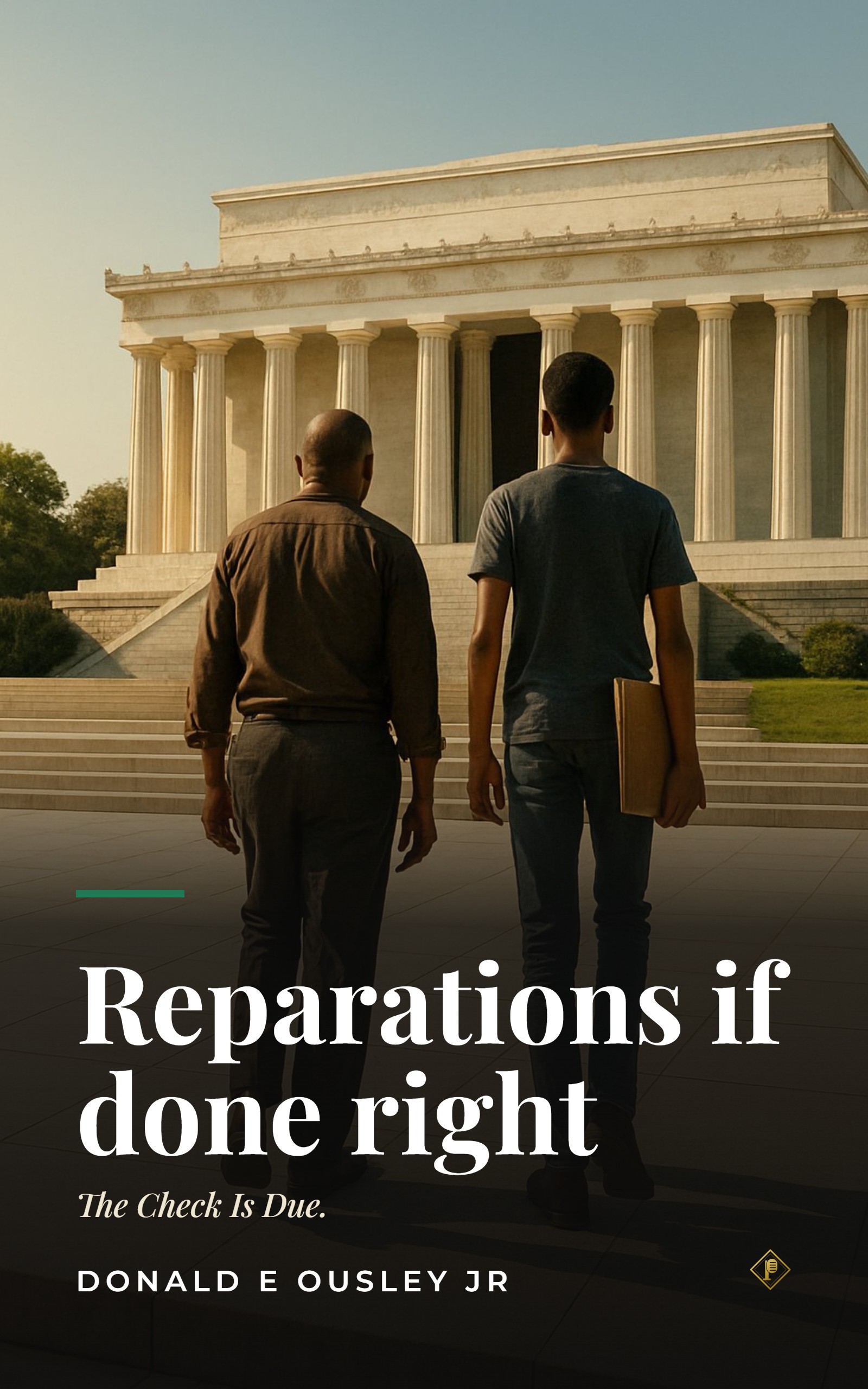
Reparations if done right
The debt owed to Foundational Black Americans, what it will take to collect it, and why it must be paid in our lifetime
by Donald Ousley
Buy now — $14.99Read it online the moment you pay — the link comes to your email.
About the book
Dr. King said it plainly before he was taken from us: it's time to go back to Washington and collect the check. Nearly sixty years later, that check still hasn't cleared. This book picks up where he left off.
Donald Ousley writes as a Foundational Black American, a veteran who watched a "guaranteed" GI Bill benefit turn out to be anything but, who watched his father and grandfather labor a lifetime with nothing to pass down. He lays out the full chain — slavery, burned townships, redlining, urban renewal, the War on Drugs, mass incarceration — and shows a wealth gap today that is no better than 1865. Not as grievance, but as evidence.
This is not a plea for sympathy. It's a ledger, a model, and a demand: cash, land, and protection, owed as debt and payable in this lifetime. For readers tired of hearing it'll never happen, this book says otherwise — and tells you exactly what done right looks like.
Read the first pages
The Check Is Due
In the summer of 1963, a preacher from Atlanta stood on the steps of the Lincoln Memorial and told this country the truth about money. Before he ever got to the dream, he called it a check. He said America had written the Negro a bad check, a check that came back marked insufficient funds, and he said it in that voice that could turn a grievance into a psalm. Five years later, in the spring of 1968, he organized a march of poor people — Black, white, brown, all of them broke in a country rich enough to be racing for the moon — and he aimed them at Washington, D.C., to collect. Not to ask. Not to hope. To collect. He was going to stand in the capital of the richest nation in the history of the world and demand they make it right, in dollars, in land, in policy, in this life and not the next one.
They shot him before he got there.
April 4th, a motel balcony in Memphis, and the check went back in the drawer, and it has been sitting in that drawer for fifty-some years drawing no interest for us and tremendous interest for everybody else. They buried the man and told us to bury the demand with him. They turned "I Have a Dream" into a lullaby, four words lifted out of a speech about a promissory note and a bounced check, four words stitched onto coffee mugs and quoted by the same politicians who have spent half a century making sure the account stayed empty. They let us keep the dream. They kept the check.
I am not here to let them keep the check.
I stood in my kitchen not long ago with my son. He is fourteen, which means he is old enough to ask me questions I used to be able to dodge and young enough that I still owe him real answers. He asked me why his friend's family — white family, two doors down — has a lake house passed down from a grandfather, and a trust his friend doesn't even know the size of yet, and college money sitting untouched since the day he was born, and why we don't have any of that. He didn't ask it mean. He asked it the way a boy asks why the sky is blue, like there had to be a simple answer and I was just being slow to give it to him.
I sat him down and I did the math out loud, because he deserved the math and not a mood.
I told him: your great-great-great-grandfather picked cotton for free for every day of his natural life, sunup to sundown, and never saw a dollar of it, and the man who owned him got rich enough to pass land down to children who passed it down to children who are still living on it today. I told him: your great-grandfather built a life in a Black town after slavery ended, a real town, with stores and schools and churches and money moving hand to hand inside it, and a mob or a policy or a highway came through and took it, and nobody ever paid him back a dime for what was his. I told him: your grandfather served this country in uniform, came home, and could not get the same loan, the same G.I. Bill benefit, the same seat at the same table as the white soldier standing right next to him in the same formation. I told him: I served this country too, and I am still fighting, right now, today, for G.I. Bill benefits I earned and was denied, because the keep-away game did not retire when the dogs and the hoses did. It just changed its clothes.
Four generations, son. Four generations of men in this family who worked themselves to the bone and had nothing to hand down when the work was done. Not because we didn't build. We built plenty. We built so much they had to burn it, zone it, redline it, incarcerate it, and legislate it out of our hands to keep us from keeping it. Four generations of starting at zero while somebody else inherited the lake house.
The story continues inside.
Inside
- 1The Check Is Due
- 2Ten Generations of Theft
- 3What We Built They Burned
- 4Legal Theft
- 5The Chain
- 6My Father's Empty Hands
- 7Who We Are
- 8They Lied About Us
- 9The Ledger
- 10No More Vouchers
- 11Who Guards the Gate
- 12The Walk to Washington
- 13Cut the Check
About the author
Donald Ousley was barely four months old when Dr. King was assassinated on April 4, 1968, just days after declaring it was time to go back to Washington and collect the check owed to Black America. Ousley has spent close to 59 years living out the truth of that unfinished business. A veteran, he found that even a guaranteed GI Bill loan came with no real guarantee when it came to him. He watched his father and grandfather work without ever being able to pass down wealth, land, or property, generation after generation starting over at zero while other Americans inherited houses, corporations, and seats of power. Ousley writes as a Foundational Black American, a descendant of the formerly enslaved, convinced that reparations are not a request but a debt this country owes and can still pay. He wrote this book to move people past the belief that it will never happen, and toward collecting what is owed, in this lifetime.
Reparations if done right
Buy now — $14.99Read it online the moment you pay — the link comes to your email.

📱 Scan to buy this book
books.platinumink.dev/book/reparations-if-done-right-4aef
Platinum Ink Publishing